Long Live the
Memory of Compañero
Juan Almeida Bosque!
September 12, 2009
Long Live the Memory of Compañero Juan Almeida Bosque!
CNC Message to Friends in Cuba in Vigil for the Five Marking 11 Years of Unjust Imprisonment of the 5 Cuban Heroes in US Jails
Dearest Compañeras y Compañeros,
The Canadian Network On Cuba, on behalf of the Canada-Cuba solidarity and
friendship movement, expresses its profound sorrow and condolences to
the Cuban people and its revolutionary leadership on the death of Juan Almeida Bosque,
Commander of the Revolution. As a historic leader of the Cuban Revolution,
Compañero Almeida was a model of revolutionary ethics and dedication to the
task of building and perfecting a society founded on justice, independence and
human dignity. During the revolutionary struggle and from the triumph of the
Revolution, Compañero Almeida stood side by side with Fidel, Raul and
Che. His life was one of steadfastness and commitment to principles and
convictions. His memory lives on in the in work of the Cuban Revolution
and its demonstration that another better world is possible.
Long Live the memory of Compañero Juan Almeida Bosque!
Long live the Cuban Revolution!
Isaac Saney & Tamara Hansen
Co-Chairs, Canadian Network On Cuba
September 12, 2009
The Canadian Network On Cuba (CNC) expresses its resolute determination to do
all that can be done to free the Five Heroes. Today we are witnessing the many
efforts by the empire to turn back the wheel of history, to hold back the
irresistible tide of the peoples? struggle for justice, independence, freedom
and human dignity. As the great humanity of Latin America and the Caribbean has
stood up and marched forward, the Five Heroes shine with even greater meaning
and courage. They are integrally connected to this great and profound
continental movement to realize in the fullest and most complete way the right
of self-determination for the peoples of these historic lands.
Cuban Parliament Calls for Intensifying the Fight for the Five Statement from the President's Office of the National Assembly
On this occasion, the CNC expresses our steadfast solidarity with the Five
Heroes, who are exemplars of the Cuban Revolution. The significance of the
Cuban revolution extends beyond the geographical boundaries of Cuba. The Cuban
Revolution established authentic self-determination, placing the Cuban nation
firmly in the hands of the people of Cuba. In the more than fifty years that
have passed since the triumph of their Revolution, the Cuban people have
resisted all attempts to take away their independence and freedom, and
re-impose foreign domination. They have repelled the unceasing all-sided
assault, military, economic, financial and propagandistic by Washington, which
has never accepted the verdict of the Cuban people.
No words can adequately convey the transcendent and singular meaning of the
Cuban Revolution. By holding aloft the banners of Justice, Peace,
Internationalism and Human Dignity, Cuba demonstrates that another better world
is possible!
We assure you that as long as our 5 heroes remain in prison, we stand with you
and will not pause in our struggle for their freedom!
Free the Five Heroes!
Long Live the Cuban Revolution!
On behalf of the Canadian Network on Cuba
Isaac Saney & Tamara Hansen
Co-Chairs, CNC
June 15, 2009
THE U.S. Supreme Court today announced, without any further explanation, its decision not to review the case of our Five compañeros unjustly incarcerated in that country for fighting anti-Cuban terrorism sponsored by the U.S. government. The judges did what the Obama administration asked them to do.
In spite of the sound arguments put forward by the defense lawyers in response to the evident and multiple legal violations committed during the entire proceedings, and ignoring the universal backing for this petition expressed in an unprecedented number of "Friends of the Court" documents - among them 10 Nobel laureates, hundreds of parliamentarians, many international and U.S. jurists' organizations and eminent political and academic figures - the Supreme Court rejected the case, ignoring the demand of humanity and its obligation to do justice.
Once again the arbitrariness of a corrupt and hypocritical system and its mercilessness toward our five brothers has been exposed.
Our fight to attain their liberation will not diminish for one second.
Now is the time to step up our actions, without leaving one space to be covered or a single door on which to knock.
We are sure that Gerardo, Antonio, Fernando, Ramón and René will continue leading this battle as they have done for the last close to 11 years.
Responding to the infamous decision, Gerardo Hernández Nordelo stated: "On the basis of our experience, the Supreme Court decision does not surprise me. I have no confidence at all in the U.S. justice system. It is now totally clear that our case has been a political case from the beginning, because not only did we have all the necessary legal arguments for the Court to review it, we but also had growing international support, reflected in the amicus briefs presented to the Court in our favor. I reiterate what I said 12 months ago, on June 4, 2008: as long as even one person is fighting on the outside, we will continue resisting until justice is done."
The struggle must be multiplied to the point of forcing the U.S. government to end this monstrous injustice and restore their freedom to Gerardo, Ramón, Antonio, Fernando and René.
President's Office of the National Assembly of People's Power
June 15, 2009
CNC Letter to Prime Minister Stephen Harper
Re: Summit of the Americas
10 April 2009
April 10th, 2009
Prime Minster Stephen Harper
Office of the Prime Minister
80 Wellington Street
Ottawa
K1A 0A2
By post, fax and email.
Dear Prime Minister Harper,
The April 17-19th, 2009 Summit of the Americas in Port-of-Spain, Trinidad and Tobago represents a potentially historic moment in which a most regrettable page in the relations amongst the nations of the Americans can finally be turned. The Summit represents an opportunity when the Canadian government can engage in the enlightened statecraft that the times require. By standing with the overwhelming majority of the nations of Latin America and the Caribbean, you can uphold the fundamental principles and norms of international law by insisting: 1. The United States end its illegal and immoral economic sanctions against Cuba; 2. Cuba is included in this and future Summits; and 3. Cuba is unconditionally re-admitted to the Organization of America States.
Latin America and the Caribbean are united in this just stand. This stand also reflects the sentiment of the vast majority of the people of Canada. Canadians irrespective of their political or ideological positions, stand in favour of building relations of genuine friendship with the island nation: relations based on mutual respect and equality that uphold Cuba's right to self-determination and sovereignty. Having traveled to Cuba in the hundreds of thousands and having witnessed Cuban reality for themselves, Canadians have come away with a profound respect and admiration for the Cuban people and their efforts to build and defend a society centered on independence, justice and human dignity.
Sincerely,
Isaac Saney
Co-chair & National Spokesperson,
Canadian Network On Cuba
Tel: (902) 449-4967
Email: isaney@hotmail. com
On behalf of the Canadian Network On Cuba
50 Years of Revolution! 50 Years of Dignity!
Statement by Canadian Network on Cuba on the Occasion of the 50th Anniversary of the Cuban Revolution
1 January 2009
The Canadian Network On Cuba (CNC) extends to the Cuban people our deepest and warmest greetings and sentiments of solidarity and friendship as they celebrate the 50th Anniversary of the triumph of the Cuban Revolution. Across Canada and though-out 2009 many events are planned to mark the significance of the Cuban Revolution. On January 1st, 1959, after a century long struggle for national affirmation, liberation and independence, Cuba embarked on the path that established authentic self-determination, placing the Cuban nation firmly in the hands of the people of Cuba. In the fifty years that have passed, the Cuban people have resisted all attempts to take away their independence and freedom, and re-impose foreign domination. They have repelled the unceasing all-sided assault, military, economic,, financial and propagandistic by Washington, which has never accepted the verdict of the Cuban people.
The significance of the Cuban revolution extends beyond the geographical boundaries of Cuba. Since its inception, the Cuban Revolution has made an invaluable contribution to the global struggle for justice, social development and human dignity. Cuba has established an unparalleled legacy of internationalism and humanitarianism, embodying the immortal words of Jose Marti: "Homeland is Humanity. Humanity is Homeland." In southern Africa, for example, more than 2,000 Cubans gave their lives to defeat the racist apartheid regime in South Africa. Today this Cuban commitment to humanity is mirrored in the tens of thousands of medical personnel and educators who have served and continue to serve across the world, battling in the trenches against disease and illiteracy.
The CNC affirms that Cuba can continue to count on the solidarity and friendship of the Canadian people, as underscored by the success of the CNC's Hurricane Relief & Reconstruction Campaign, which has raised hundreds of thousands of dollars in financial and material assistance from numerous individuals and organizations. This outpouring of support and empathy for Cuba is indicative of the sentiment of the vast majority of Canadians. Having traveled to Cuba in the hundreds of thousands and having witnessed Cuban reality for themselves, Canadians have come away with a profound respect and admiration for the Cuban people and their efforts to build a society centered on independence, justice and human dignity. Irrespective of their political or ideological positions, Canadian stand for the building of genuine friendship with the island nation: relations based on mutual respect and equality and recognition of Cuba's right to self-determination and sovereignty.
On the occasion of the 50th Anniversary of the Cuban Revolution, the CNC commits itself to strengthening Canadian solidarity and friendship with Cuba by stepping up the work to free the five Cuban Heroes unjustly imprisoned in the U.S. for defending their country from terrorism, and ensuring that Canada-Cuba relations remain based on equality and respect for the right of Cuba to self-determination.
No words can adequately convey the transcendent and singular meaning of the Cuban Revolution. By holding aloft the banners of Justice, Peace, Internationalism and Human Dignity, Cuba demonstrates that another better world is possible! In a world fraught with intense and significant challenges, in the spirit of the 50th Anniversary of the Cuban Revolution we declare:
Another Better World Is Possible!
LONG LIVE THE CUBAN REVOLUTION!
50 Years on... and the Same Challenge of Making Revolution
Lázaro Barredo Medina, Granma International
"The dictatorship has been defeated. The joy is immense. And yet, there still remains much to do. We won't deceive ourselves by believing that everything will be much easier from now on; perhaps it will be much more difficult."
This is what Commander in Chief Fidel Castro told the people on January 8, 1959, the day of his entry into Havana. Many people could never imagine the immense challenge that they would live to experience.
Suffice it to say that just a few days later, Fidel proclaimed the right to self-determination in terms of relations with the United States and immediately, the aggressions, attempts on his life and anger on the part of U.S. politicians began, evidence of which can be seen in speeches and articles of the time, as in an editorial of Time magazine, the mouthpiece of the most conservative sectors, entitled: "Fidel Castro's neutralism is a challenge for the United States."
But the Cuban people could not be neutral in the face of the United States. The triumph of the Revolution that January 1959 signified for the Cuban nation, for the first time in its history, the real possibility of exercising the right to self-determination. From that moment on, neither the U.S. president, Congress nor its ambassadors could continue making decisions on what could or could not be done in Cuba. The bitter dependence had been brought to an end; a dependence that saw U.S. governors and ambassadors enjoying a degree of power in Cuba that was far greater than the actual power that they had -- with respect to decision-making -- within the U.S. federal government or in relation to any of the 50 states that make up the USA.


Click On Photo for Larger Image
When full national independence was achieved, the Revolution began to exercise that right by immediately applying the program that Fidel had announced during the Moncada trial of 1953 and which is contained in his historic self-defense speech History Will Absolve Me.
Cuba established the economic and social regime that it believed was most just and established a socialist state with participatory democracy, equality and social justice.
The country's economy was characterized by limited industrial development, essentially depending on sugar production and a latifundia agricultural economy, where landowners controlled 75% of the total arable land.
Most of the country's economic activity and its mineral resources were managed by U.S. capital, which controlled 1.2 million hectares of land (a quarter of the productive territory) and most of the sugar industry, nickel production, oil refineries, the electricity and telephone services and the majority of bank credits. Likewise, the U.S. market controlled approximately 70% of Cuban imports and exports, within a system of highly dependent volumes of exchange: in 1958, Cuba exported products worth 733 million pesos and imported 777 million pesos worth of goods.
The prevailing social picture was characterized by high unemployment and illiteracy, a precarious healthcare, social assistance and housing system for the vast majority of the population, as well as abysmal differences in living conditions between urban and rural populations. There was a high degree of polarization and unequal distribution of income; in 1958, 50% of the population earned just 11% of total income, while a 5% minority controlled 26%. Racial and gender discrimination, begging, prostitution and social and administrative corruption were widespread.
Addressing the social and economic problems in Cuban society could no longer be put off and could only be resolved if the Cuban people had control of their own wealth and natural resources. Thus, using the 1940 Constitution and in line with international law, Cuba exercised its right to take control of these resources and assumed total responsibility for this action. The island paid compensation to all nationals from third countries (Canada, Spain, Britain, etc.) with the exception of U.S. nationals, given that that government rejected the provisions outright and transformed the Cuban government's decision into a pretext for unleashing a war unprecedented in the history of bilateral relations between the two nations.
Not only did the Revolution hand over land to campesinos who, up until then, had been subjected to semi-feudal conditions of production and forced to live in extreme poverty, but it also determined that all the country's resources should be allocated to national economic development and improving the material and living conditions of the population. To give just one example, in the 1980s alone, approximately 60 billion pesos were allocated to the construction of productive and social facilities.
The process of industrialization underway paved the way for economic and productive diversification. Under the Revolution and up until the economic crisis which began with the disintegration of the Soviet Union and the East European socialist bloc between 1989 and 1991 -- what we in Cuba call the Special Period -- the country's capacity for producing steel grew 14-fold, fertilizer increased six-fold, the oil refining industry quadrupled (not counting the new refinery in Cienfuegos), the textile industry grew seven-fold, tourism three-fold, to mention but a few. The state also created complete ranges and new industries such as machinery, mechanics, electronics, the production of medical equipment, a pharmaceutical industry, construction materials, a glass industry and ceramics, as well as making investments to increase and upgrade the sugar, food and light industries. In addition to these endeavors, we have the development of biotechnology, genetic engineering and other branches of science.
The country has also made great efforts in terms of improving its infrastructure. Electricity generation has risen eight-fold and water storage capacity has increased 310 times, from 29 million cubic meters in 1958 to nine billion-plus cubic meters today. There has been diversification with respect to roads and freeways and modernization of ports and other areas. Social needs have been covered fairly well, except for housing, which has been Cuba's biggest problem.
The progressive growth and diversification of productive potential and the application of a widespread social program has allowed the nation to confront the problem of unemployment. In 1958, with a population of six million inhabitants, approximately one third of the economically active population was unemployed. Of this figure, 45% of the unemployed lived in rural areas while, out of 200,000 women in work, 70% were employed as domestic servants. Today, with 11 million inhabitants, the number of people in work is in excess of 4.5 million. Over 40% of workers are women and today they represent more than 60% of the nation's technical and professional sectors.
In 1958, the number of illiterate and semi-illiterate people in Cuba stood at two million. The average academic level of 15-plus year-olds was third grade, more than 600,000 children did not attend school and 58% of teachers were unemployed. Just 45.9% of school-age children were enrolled and half of them did not attend classes. Only 6% of those enrolled finished elementary education. Universities were available to just 20,000 students.
The education sector received immediate attention from the revolutionary government. Its first task was to develop a mass literacy campaign with the participation of the population. An extensive network of schools was constructed throughout the country and more than 300,000 teachers and professors were in fulltime employment in this sector. The average academic level for those aged 15-plus year-olds rose to ninth grade. One hundred per cent of school age children are enrolled in schools, some 98% complete elementary education and 91% complete junior high. One in every 11 citizens is a university graduate and one in eight has technical-professional qualifications. There are 650,000 students in the country's universities today and all education is free of charge. Education and vocational skills are also guaranteed for 100% of children with physical or mental disabilities, who attend special schools.


Click On Photo for Larger Image
The precarious situation in 1958 with respect to public health was characterized by an infant mortality rate of 60 per 1,000 live births and a maternal mortality rate of 118 per 10,000. The mortality rate for those suffering from gastroenteritis was 41.2 per 100,000, and from tuberculosis, 15.9 per 100,000. In rural areas, 36% of the population suffered from intestinal parasites, 31% from malaria, 14% from tuberculosis and 13% from typhoid. Life expectancy at birth was estimated at 58.8 years.
Around 61% of hospital beds and 65% of the nation's 6,500 doctors were concentrated in the capital. In the other provinces, medical coverage was one doctor for every 2,378 inhabitants and there was just one hospital for all the country's rural areas.
Today, healthcare is free of charge and Cuba has more than 70,000 doctors, providing coverage of one for every 194 inhabitants. Almost 30,000 of them are providing services in over 60 different countries. A national network of more than 700 hospitals and polyclinics has been created. Thanks to a widespread vaccination campaign (every child currently receives vaccines against 13 different illnesses) diseases such as polio, diphtheria, measles, whooping cough, tetanus, rubella, mumps and hepatitis B have been almost entirely eradicated. The infant mortality rate is 5.3 for every 1,000 live births and life expectancy exceeds 77 years.
There is also a series of advanced medical services that are not considered as "basic" in the international arena, and are provided completely free of charge, such as intensive care units in pediatric and general hospitals, cardiovascular surgery, transplant services, special perinatal care, treatment for chronic renal failure, and special services for occupational and physical rehabilitation.
The revolutionary state did not focus its attention solely on economic and social measures. It also embarked on efforts to establish an internal legal system to facilitate the right to self-determination via the population's direct participation in discussions, analyses and the passing of the country's principal laws. The most notable of these was the 1976 Constitution, supported by 97% of Cubans aged 16 and over through a referendum, as well as other momentous laws like the Penal Code, the Civil Code, the Family Code, the Children and Young People's Code, the Labor and Social Security Code and many others.
Likewise, the self-determination of the Cuban people is expressed through the right to defend the nation against foreign aggression. Today, more than four million Cubans -- workers, campesinos, and university students -- are organized in militia groups have access to weapons in their campuses, factories and in rural areas.
However, since 1959, Cuba has had to confront the hostility of 10 U.S. administrations that have attempted to limit its right to self-determination through the use of aggression and the unilateral imposition of a criminal economic, commercial and financial blockade.
One of the universally accepted principles of international law is that state cannot be allowed to coerce another in order to deny it the right to exercise its sovereign rights. Article 24 of the UN Charter states that, in the context of international relations, nations must refrain from using threats or force against the territorial integrity or political independence of any state.
Over the past 45 years, the United States has prohibited any trade with Cuba, including foodstuffs and medicines; it cancelled the Cuban sugar quota; prohibited its citizens from traveling to Cuba via the imposition of heavy sanctions; prohibited the re-export of U.S. products or items containing U.S. components or technology to Cuba from third countries; prescribed that banks in third countries should maintain Cuban bank accounts in dollars or use that currency in their transactions with the Cuban nation; has systematically intervened to prevent or hinder trade with or financial assistance to Cuba on the part of governments, institutions and citizens from other countries and international organizations.
In the 1960s these reprisals forced Cuba to structurally reconstitute its economic relations when and establish its essential markets in countries in the former East European bloc -- specifically in the Soviet Union -- which meant that the country had to embark on an almost total re-conversion of its industrial technology, means of transport, and provisions, etc.
When Cuba lost its natural markets in Eastern Europe, the U.S. government intensified its blockade via the 1992 Torricelli Act, which used the pretext of "democracy and human rights" to prohibit U.S. subsidiaries located in third countries and subject to the laws of those nations from engaging in commercial or financial operations with Cuba (particularly in respect to food and medicines), and punishing these by prohibiting the entry into U.S. ports for 180 days of vessels transporting goods to or from Cuba or on behalf of Cuba, measures that -- given their extraterritorial nature -- do not just prejudice Cuba but also harm the sovereignty of other nations and the international freedom of transportation.
On March 12, 1996, the U.S. government passed the Helms-Burton Act, further aggravating relations between the two countries and assuming the right to sanction citizens of third countries in U.S. courts, as well as determining their expulsion or denying them and their families entry visas into the United States, with the aim of hindering Cuba's efforts to recover its economy and hampering its possibilities of securing a greater insertion in the international market. That was also a way of attempting to pressure the Cuban people into relinquishing their efforts of self-determination.
More recently, it has adopted the Bush Plan, an attempt to transform Cuba into a colony through an annexationist program and the sibylline intention to intervene via a pretext of "transition," a scenario in which the State Department would entrust one of its leaders as "governor," when the Cuban revolutionary state disappears. This plan, with which George W. Bush decided "to precipitate the day when Cuba becomes a free country," has intensified the blockade and pressure on the Cuban people by repressing family relations between Cubans resident in the United States and their families on the island; grants million-dollar resources to terrorist groups in Miami, as well as to mercenary subordinates in the U.S. Interests Sections in Havana; and promotes formulas to destabilize the country and redouble international pressure on the island.
That hostility on the part of the U.S. has included other notorious manifestations of aggression, ranging from the military aggression through the Bay of Pigs in 1961, the dirty war carried out by counter-revolutionary gangs heavily supplied by the U.S. CIA, bacteriological warfare on agricultural crops (sugar, tobacco, and citrus fruits), animals (swine fever), and humans (hemorrhagic dengue), to sabotage plans, bombings using pirate planes, and assassination attempts on the country's principal leaders.
The actions of terrorist organizations executing military attacks on Cuba from U.S. territory are notorious, and are publicized and fomented by the Miami media. Groups are constantly recruiting adventurers who are willing to head off to Cuba as agents and saboteurs, who openly declare that they have no fear whatsoever of being brought to justice in U.S. courts.


Click On Photo for Larger Image
That is why Cuban patriots have had to leave aside their personal interests to serve those of the nation, even sacrificing their family relationships, in order to infiltrate the ranks of those terrorist groups in order to discover their activities and, with this information, prevent the bloodshed of Cuban and U.S. people. They are willing to pay the price of the political irrationality of the U.S. government, as is the case of the five Cuban heroes unjustly incarcerated in U.S. jails for combating terrorism.
The above is compounded by the heavy military mechanism created by the United States around Cuba and its constant tension-generating activities, as well as the illegal occupation of the Guantánamo Naval Base on Cuban territory (today converted into a horrific prison camp), a part of Cuba rented out by force to the United States in the early 20th century and which the U.S. government refuses to return.
In the early 90's, with the disappearance of the Soviet Union, isolated and reviled by the international reaction, Cuba absorbed the terrible blow of losing the bulk of its markets in a matter of months and an abrupt descent in its gross domestic product. But the island confirmed that it shone with its own light and that it had never been a satellite of anyone, given that it was able to face that juncture on account of the extraordinary resistance of the majority of Cubans, who have acted on the basis of authentic motivations, values and ethical principles.
The Cuban people have made a conscious decision to support the country's leadership, not only because they identify the system with their own interests, but also because of the responsible manner in which the state took on the crisis, reorganized its forces and designed a recovery strategy, despite the U.S. blockade and conditions imposed by its European allies.
The sacrifices provoked by that situation have been hard, but it has been possible to endure them because of the undisputed social advances attained, because of the confidence deposited in the country's leading institutions and because of people's appreciation that their government is not a decadent one or one that is in management crisis or lacking in strategies, but has confirmed that the population has remained at the center of all its work, even in the most difficult circumstances.
Fifty years have gone by and the liberation process has reached this point following the same direction indicated that night, 50 years ago, when Fidel, speaking to the huge crowd awaiting him in what was the dictatorship's headquarters, affirmed that everything could be more difficult in the future, because we would have to fight to make the Revolution.
That is the challenge of the struggle currently underway to eradicate vices and exalt virtues, with Fidel as a soldier of ideas serving as a compass in the fight for freedom and independence.
Cuba's enemies are backing their all on the opposite of that. In this world, where politics is a caricature, they cannot comprehend that, in its thinking and action, this Revolution is a process of continuity, and that Fidel will continue to be the leader of the Revolution of today and tomorrow, because, beyond responsibilities and titles, he will continue to be the counselor of ideas to which we will always have recourse, because he has transcended political life to insert himself in an intimate way in the family life of the vast majority of Cubans.

Click On Photo for Larger Image
Renewed Request to Canadian Government for Cuban Hurricane Relief
Keith Ellis, Canadian Network on Cuba
8 November 2008
Dear Prime Minister,
In your kind reply to my letter of September 16, in which I had asked that our government give significant aid to Cuba for hurricane relief, you indicated, in a tone that suggested that my request would be given careful consideration, that you had forwarded my request to the Minister of Cooperation Beverley J. Oda. It is very likely that the period of campaigning for the general elections distracted the Honourable Minister from attention to that correspondence, because I have not heard from her. Now that the damage caused by the hurricanes about which I had written has been assessed to amount to more than $8 billion, I am writing to you again to ask that prompt consideration be given by your government to supplement the preliminary amount of $400,000 which you gave unofficially to Cuban organizations.
I am prompted to do this by many factors. First, other governments have now been following up on their initial emergency responses with meaningful official donations. The government of Spain, for example, which initially donated 2 million euros, has now increased that allocation to the Cuban government by an additional 24.5 million euros. The European Community will make available to Cuba between 25 and 30 million euros, in addition to an initial donation of 2 million euros. Equatorial Guinea is giving two million euros. Trinidad and Tobago has given a million dollars, East Timor half a million, and Namibia one million. What is more, several hundred Canadians, to this point, have donated close to $500,000, mostly as cash but also in goods, as the result of the campaign that I have organized for the Canadian Network on Cuba. Several other groups, including Oxfam and the Orion and the Dubois Foundations, have been having good responses from the Canadian people. And, aware of the fact that it is the Cuban government that bears the responsibility and the expense for protecting the population from the dangers of on-coming hurricanes and for rebuilding such things as the devastated housing stock (591,194 houses were affected, of which 89,541 were totally destroyed), the bulk of these donations are going appropriately to the Cuban government.
I note that first among the issues you wish to take up with the new president-elect of our good neighbours to the south is the matter of climate change and the environment. Official and significant aid to Cuba for hurricane relief would be in that context a way of recognizing the fact that the island is not at all to be blamed for the increasing number of meteorological disasters from which it and other Caribbean countries are suffering. The World Wildlife Fund found two years ago that, of all the countries on our planet, Cuba is the only one that met that organization' s criteria for sustainable development. Now as I write, yet another hurricane, Paloma, a category 4 hurricane, is bearing down on central Cuba.
Our diplomatic relations with Cuba, established in 1945, have been uninterrupted; and relations have been good between our countries. Our country is third among the countries that have businesses in Cuba. Our country has the most visitors to Cuba. Many of the Canadians who have donated have been concerned that so far there has been no significant official Canadian donation to Cuba for hurricane relief. May I point out that the donation does not need to be fully in cash. Cuban agriculture has been so devastated by the hurricanes that there is an urgent need for food supplies, for wheat, potatoes, grains, etc., which we have here in some abundance. And of course building materials, especially roofing materials, would be welcomed.
I and many other Canadians, perhaps nearly all Canadians who are aware of the extent of the natural disaster, hope that we can soon have the good news that our government has followed up with a significant contribution to Cuba for hurricane relief. I hope to hear from you soon.
Yours sincerely,
Keith Ellis FRSC, Professor Emeritus
Dept. of Spanish and Portuguese, University of Toronto
Chair, Hurricane Relief Committee
Canadian Network on Cuba
cc: Beverley J. Oda, Minister of Cooperation
Government of Canada, House of Commons
Ottawa, ON K1A 0A6
Phone: (613) 992-2792
Fax: (613) 992-2794
Email: Oda.B@parl.gc. ca
Email: info@acdi-cida. gc.ca
The Third Hurricane
Reflections by Comrade Fidel Castro,
Granma International
7 November 2008
It could lose strength but it is already raining in most of the country. It's raining on farming areas absolutely drenched by the recent rainfalls. The water reservoirs filled up to almost full capacity due to hurricanes Gustav and Ike will be releasing water on cultivated fields and valleys. This already happened at the end of August and early September. This hurricane has been given the misleading name of Paloma [Spanish for "dove" -- TML Ed. note].
After countless hours of labor, many crops almost ready for harvesting as well as fuel, seeds, fertilizers, herbicides and the work of the equipment used to urgently grow food will again be lost.
In many places where the families awaited for and received materials to repair their homes, and where they excitedly applauded the workers who were reestablishing electricity so vital to many services, will again partly live through the same experience.
Once again destruction will revisit highways, roads and other works in various provinces of the country.
The latest report from the Meteorology Institute's National Forecast Center has confirmed the inexorable development of the event. Nevertheless, we should not be discouraged by adversity. Paloma is not covering such an extensive area as Gustav.
Our people should learn from every such event about the consequences of climate change and the ecologic unbalance, which are some of the many problems humanity is facing.
The initial estimates of the economic damages caused by the two previous hurricanes were short of reality. The losses amounted to 8 billions instead of the 5 billions originally announced. This time there will be additional damages.
The cadres who are decidedly and restlessly coming to grips with the problems shall insist on demanding from their compatriots that they respond to these adverse circumstances with hard work in both production and services.
And, if the chief of the empire and leading promoter of the genocidal blockade on our country were to offer again his pious assistance, he would again receive a dignified response: it would certainly be rejected. Our people demand that the blockade is lifted, especially now that humanity has unanimously called for it amidst a financial crisis which is pounding on every developed and developing nation on the Earth.
There are still some who dream of submitting Cuba using the criminal blockade as an instrument of the U.S. foreign policy against our homeland. If that country made the same mistake again it could spend another century implementing that useless policy against Cuba; that is, if the empire could last that long.
Fidel Castro Ruz
November 7, 2008
8:24 p.m.
Fidel, Chief Inspiration for
Cuban Medical Cooperation
Enrique Milanés León,
Granma International
5 November 2008
Without the Comprehensive Health Program, the world's population would be different. More than two million human lives have been saved by Cuban medical personnel in various underdeveloped nations throughout the world in the last 10 years, thanks to the fundamental pillar of solidarity developed by the Revolution.
José Ramón Balaguer Cabrera, member of the Political Bureau and minister of public health, noted at a gathering marking the 45 years of Cuban medical cooperation that in saving lives, knowing how to make patients feel like human beings is more powerful than empty medical or scientific knowledge. It is in that principle that Cuba is training some 24,000 medical students from other countries, who win the affection and recognition of their communities when they return.
Balaguer Cabrera noted that Cuba's health system is based on primary care, rooted in the ideas of (Fidel Castro's) History Will Absolve Me, and whose first protagonists were the guerrilla doctors of the Sierra Maestra.
One thousand delegates, including internationalist medical personnel, students and graduates of the Latin American School of Medicine (ELAM) and journalists with experience in covering these missions, agreed on the importance of a practice that, as of August of this year, had taken more than 185,000 medical specialists and technicians from the island to 103 Third World nations.
Recognition of the chief inspiration for these actions was summed up in the certificate sent to Fidel Castro with a photograph of him donating blood to help victims of the earthquake in Peru in July 1970, a gesture that was followed by more than 100,000 other Cubans.
The gathering was presided over by Ramiro Valdés Menéndez, Salvador Valdés Mesa and Concepción Campa, members of the Political Bureau; Roberto Morales, member of the Central Committee Secretariat; Felipe Pérez Roque, minister of foreign affairs; and José M. Miyar Barrueco, secretary of the Council of State. Prominent individuals from dozens of agencies related to health programs and representatives of the accredited diplomatic corps in Havana were also present.
Solidarity had many voices. Doctor Patrick of Haiti noted that Cuba has never stopped treating his brothers and sisters with dignity; his Honduran colleague Andrés Aguilar commented on the collective determination to improve the world, and another Honduran doctor, Luther Castillo, explained how much good can be done in other nations based on what he learned in ours.
The heads of Cuba's medical missions in Guatemala, Timor Leste and Haiti talked about the fruits of internationalist cooperation in those nations, both in terms of direct attention provided by Cuban specialists and in the consolidation of human capital in those places based on the education provided by our doctors.
Journalists reaffirmed their will to continue their beautiful coverage under whatever conditions are established by the country's leadership.
Special recognition was given at the event to the first three brigades of the Comprehensive Health Program: Guatemala, Honduras and Haiti, as well as reporters who participated and 43 agencies and institutions that have significantly contributed to Cuba's medical cooperation abroad.
10th Anniversary of Comprehensive Healthcare Program: Practicing What We Preach
José A. De La Osa, Granma International
3 November 2008
On November 3, 1998, just five days after the powerful Hurricane Mitch lashed Central America, a Cuban medical brigade inaugurated a cooperation project in Honduras, namely the Comprehensive Healthcare Program, which is now celebrating its 10th anniversary.
The brigade, comprising 12 cooperative workers, immediately embarked on their welfare tasks in the region of La Mosquitia which, according to initial estimates, was the area that had suffered the most damage as a result of the hurricane. But once the Cuban government discovered the magnitude of the disaster, it continued to send brigades until there were 119 cooperative workers in the country at that time.
In an interview with Granma, Dr. Elis Alberto González Polanco, head of the first brigade, recalls that when they arrived in the extensive plain of La Mosquitia, they found a "devastated land, almost total destruction of the subsistence base" of an estimated population of 60,000 inhabitants.
"We were the first humanitarian brigade to arrive in Honduras," he says, "and we transported seven tons of surgical equipment and medicines, two field hospitals with beds, mattresses, and food and water supplies to last for more than a month."
A Look at the Origins
Although Cuba began the tradition of healthcare internationalism more than 45 years ago when a medical brigade went into Algeria, Fidel's idea of developing a Comprehensive Healthcare Program (CHP) has its most concrete and objective expression in the application of activities designed for free medical assistance in Latin America and the Caribbean, which was later extended to Africa and Asia, and includes the training of professionals -- in their own countries and in Cuba -- in order to guarantee the sustainable development of this cooperation.
With this aim in mind, one significant contribution was the creation -- in 1999 -- of the Latin American School of Medicine (ELAM) in Havana, which now incorporates 33 different faculties for students who enroll for the New Training Program for Latin American Doctors, plus the Faculty of Nursing.
There are currently almost 23,000 young people originating from Third World nations studying Medical Science in our country.
In the historical context, the idea of this new program initially emerged in response to the tragic consequences arising from two hurricanes that devastated the Caribbean (George) and Central America (Mitch). It was after George -- on September 28, 1998 -- when Fidel first suggested the idea of a Comprehensive Healthcare Program for Haiti. Subsequently, Cuba offered to send, free of charge, Cuban doctors to Central America after Mitch lashed the region.
A Tale to Tell
The last 10 years since the CHP was devised have passed "in the blink of an eye," says Gonz?lez Polanco, a surgery specialist who, from November 1998 to 2002, headed up a medical brigade in Honduras. Subsequently, and for almost five years, he was Cuban ambassador to that country and finally, at the end of his mission, he was appointed director of the Central Unit of Medical Cooperation at the Ministry of Public Health, a post that he currently holds.
Polanco, as he is known, has no doubts in confirming that this continues to be one of the most beautiful experiences of his life, because the CHP "is a hand that reaches out" to the most needy people in the most inaccessible places and, for this noble project, the Revolution boasts thousands of healthcare workers with a social vision and a solidarity-driven vocation who are committed to, at the very least, alleviating the wounded face of poverty.
On a personal level, he indicates, his internationalist work as a doctor has significantly contributed to enriching his professional career, helping him to be a better and more humane doctor, more revolutionary, and more convinced of the just principles which Fidel has always defended.
He remains deep in thought for a moment, before finally recalling: "A few weeks after our arrival in La Mosquitia, a representative from the Elders Council of one of the indigenous groups -- the Tawahka -- that inhabits this Honduran region, came to see us because they had a high infant mortality rate and extremely low life expectancy (around 40 years) and were afraid that, as an ethnic group, they would be wiped out.
"I will never forget that after several years of preventative and curative labor by Cuban doctors, the Tawahka's infant mortality rate fell from 250 deaths per 1,000 live births to less than 20, and at the same time, their life expectancy rate rose by several years. Is it not stories such as this that truly define how wonderful it is to be able to engender human solidarity?"
Figures That Are Facts
- Cuban medical cooperation, in a variety of modes, is currently being offered in 73 countries. Of these, the Comprehensive Healthcare Program is underway in 43 while 30 are receiving Compensated Technical Assistance. Operation Miracle is underway in 19 countries and has now passed the one-million mark with respect to sight operations.
- There are currently 38,544 Cuban healthcare workers on a variety of missions throughout the world, of which 17,697 are doctors.
- Through the Comprehensive Healthcare Program alone, some 117,798,248 patients have been seen, 2,831,870 of whom have received operations. Conservative figures indicate that during the 10 years since the program began, the lives of almost two million people have been saved.
Hurricane Relief: First Gustav, and Now Ike
2 September 2008
Dear Friends,
Gustav and Ike have caused the worst storm damage in Cuba’s history. As you already know, Cuba has once more suffered the fierce attack of a hurricane. This one, Gustav, is considered to be the most devastating in the last forty years. Having caused severe flooding in its early stages in eastern Cuba, it grew in strength and size in the warm Caribbean waters and, after demolishing the special municipality of the Isle of Youth with its awful force, invaded Pinar del R?o, Cuba’s most westerly province. By this time it had achieved a diameter of some 450 kilometers with the most destructive winds and rains packed into the eastern side of the monster. Although Pinar del R
UN assessment is 4 to 6 billion in damages for Cuba. The Cuban government has issued their preliminary estimate of the damage wrought by hurricanes Gustav and Ike. It makes for sobering reading. The total damage is estimated at $5 billion and can rise, with more than 440,000 homes damaged, more than 63,000 totally destroyed. For details on agriculture/businesses/ infrastructure, etc, the extensive report is available at:
http://www.granma.cubaweb.cu/2008/09/16/nacional/artic03.html
The damage touched all sectors of the economic and social life of various regions, and with Ike the whole island. In large parts of Pinar del R?o and Isla de la Juventud, houses, schools, hospitals and other public buildings that weren't demolished, lost their roofs or suffered other kinds of damage. This means that warehouses that stored supplies and commodities such as rice, sugar, flour, tobacco, could not avoid exposing them to the elements. Cultural and recreational facilities were damaged or destroyed. Ferris wheels were turned into mangled metal, as were transmission towers used for electricity or communications. Damaged high-tension power lines, roads and bridges added to the toll. The agricultural sector has suffered severely. Hundreds of hectares of bananas fell early, as did citrus fruit. Sugar cane was massively affected, and sophisticated irrigation equipment was ruined. The part of the fishing industry based in the Isla de la Juventud was gravely hurt.
The good news is that, thanks to the precautionary measures, in which Cuba leads the world and which involved moving a quarter of a million people to safe shelter, not a single life was lost during Hurricane Gustav. Five lobster fishermen who were missing at sea for a time were found after an intensive air and sea search. For Ike, almost a quarter of the whole population of Cuba was evacuated. Five died with Hurricane Ike and for Cuba that's a very high total.
Cuba, like other Caribbean countries and parts of the United States, occupies a geographical space that is in the path of hurricanes. This space is now more prone then ever to disastrous hurricanes as a result of climate change. Hardly had Gustav passed than Hanna and Ike appeared on the weather map like a caravan of doom. Cuba is the country least to be blamed for the deteriorating climatic conditions that fuel hurricanes. Let us remember that when the World Wildlife Fund in 2006 evaluated countries, human development and environmental protection, they found that Cuba was the only country that met the criteria.
Hurricanes will continue to batter Cuba. The island can frustrate them only to a certain extent, chiefly through deepening scientific knowledge of their behaviour and the achievement of a social organization based on solidarity, trust, egalitarianism and fairness.
The day after Gustav passed, the civil defense plans were put into immediate action - involving the whole island to help the devastated areas. Roads were being cleared and swept, food was being shipped to affected areas from provinces that were better supplied, linemen were arriving in Pinar del R?o from Santiago to work "as long as is necessary," and public health brigades were ensuring salutary conditions. Building materials were being distributed to those who needed repairs to their homes. The energy revolution has introduced technologies that have resulted in speeding up the restoration of electricity after damage to the grid. The presidents of the Defense Councils of Pinar del R?o and Isla de la Juventud, both women, were received in the various communities they visited, with cheerful demonstrations of confidence in them and the Revolutionary government.
A badly damaged hospital in one of the communities in Pinar del R?o was the place of birth of a boy during the hurricane. He was named Gustavo for the hurricane and David for the Cuban people's spirit of fighting against great odds.
That fighting spirit must also be imbued with the patience of Sisyphus, because the unwanted meteorological phenomenon stubbornly recurs. A previous CNC donation went precisely to one of the again affected Pinar del R?o communities to provide roofs for some 200 houses. We hope that some of these roofs have survived. The fighting spirit must also be buttressed by financial resources.
Even though Cuba has not requested aid from us, the friends of Cuba, including members of the Canadian Network on Cuba, will want, as they usually do, to do everything possible to help. Cuba has been helping other countries for years; now let us help them.
Help by signing a petition to the Canadian Federal government to send Hurricane Aid to Cuba. Go to the website for Canadians: www.gopetition.co.uk/petitions/hurricane-aid-for-cuba.html Please pass the info on; also write your MP.
With your help - in view of the great expense - we should imaginatively seek out new additional sources of funds - from different levels of government, farmer's associations, trade unions, cultural groups - and in general widen the circle of the friends of Cuba. We should work to include people who are indignant at injustice, those who understand, for example, that one of the main reasons why the Bush administration let some of its citizens die rather than accept Cuban medical help at the time of Katrina was because they wanted no easing of their brutal 'embargo', and even when Cuba is faced with terrible natural disasters. Let us approach Canadians with some of the information here and, as José Mart? would do, believe in their goodness.
The need for funds to recover from Hurricane Gustav and Ike is urgent. We aim to forward to Cuba an initial contribution of $100,000 as soon as possible. We hope that in this hour of Cuba's need, you will find it possible to respond in a spirit that reflects the generosity and determination of the Cuban people.
One hundred per cent of your donation will go to Cuba either directly or in obtaining and shipping requested materials to help in the re-construction. The charitable organization "Mackenzie-Papineau Memorial Fund" (Registered Canadian charitable organization # 88876 9197) is working with us to collect donations for Cuba Hurricane Relief and Re-Construction from concerned Canadians. Either way, you will receive a charitable tax receipt:
There are two ways to send in donations.
1) Send your cheque made payable to the "Mackenzie-Papineau Memorial Fund." Then write on the memo line of the cheque "For Cuba Hurricane Relief." Also include your name, address if it is not already on the cheque so a tax receipt can be issued (or state that a tax receipt is not needed).
Mail to:
Mackenzie-Papineau Memorial Fund Attn: S. Skup, Treasurer,
56 Riverwood Terrace,
Bolton, Ontario, L7E 1S4
(tel: 905.951.8499 sharon@ccfatoronto.ca)
If you do not want any receipt, you also can go to any TD Canada Trust branch and deposit money to the account of the Mackenzie-Papineau Memorial Fund: (Institution # 004; Transit # 03212) Branch # 321 Acct# 5001074.
2) Make out your cheque (or cash) to your local Cuba friendship/solidarity committee with your name, address, clearly stating "For Cuba Hurricane Relief." The local committee will send one cheque - together with a list of the names, addresses, and the amount of the donation of the individual donors - to the Mackenzie-Papineau Memorial Fund. Tax receipts will then be issued to individual donors (unless stated as not needed). A list of provincial groups is available on the CNC website.
Yours in solidarity,
Keith Ellis,
Chair Cuba Hurricane Fund Committee, Canadian Network on Cuba
MEDIA RELEASE
56 MPs SIGN LETTER OF SUPPORT FOR THE CUBAN FIVE
July 7, 2008
Canadian Network on Cuba Statement
Jointly with La Table de Concertation de Solidarité Québec-Cuba
On the initiative of Francine Lalonde, Bloc Québécois MP for La Pointe-de-l'île and Foreign Affairs critic, 56 Members of Parliament signed a letter demanding justice for the Five Cubans imprisoned in the United States and for their families. In a good collaborative gesture with the Bloc Québécois, Libby Davies, MP for Vancouver East, organized the letter signing within the New Democratic Party.
The letter explaining the case of the Five was signed by 40 Bloc Québécois and 16 New Democratic Party MPs. During the week of June 23-27, 2008 the letter was forwarded to the Honourable David Emerson, Minister of Foreign Affairs of Canada with copy to Mr. Michael Mukasey, Attorney General of the United States, and Mr. David Wilkins, Ambassador of the United States to Canada.
The letter indicates that Fernando González Llort, René González Sehwerert, Antonio Guerrero Rodríguez, Gerardo Hernández Nordelo and Ramón Labañino Salazar, known internationally as the "Five" and imprisoned in the United States for more than 9 years, have undergone an unfair trial and conditions of detention which contravene the Constitution of the United States and international law. The letter signed by 56 MPs hinges, inter alia, on Amnesty International,on the United Nations Working Groupon arbitrary detentions, which stems from the United Nations Commission on Human Rights, and also on a group of 110 British members of Parliamentwho denounced the conditions of the trial and the imprisonment. The letter also mentions that these five people are held in five separate maximum security prisons and are kept for long periods in isolation cells; two of them have been denied their right to family visits. It also states that, since the Atlanta Court of Appealdeclared that the verdicts against the Cuban Five were invalid, nothing justifies their imprisonment any longer or the arbitrary situation that is extremely painful for the Cuban Five and their families.
In 1998 the Cuban government had given to the American authorities a thick report which showed that terrorist acts were being plotted on American soilby anti-Cuba groups living primarily in Miami. The information was gathered largely from data collected by the Cuban Five who had infiltrated these groups; but rather than acting on this information, it was the Cuban Five who were arrested on September 12, 1998.
Other members of Parliament in the world have denounced the injustice made against the Five and their families, such as Karel De Gucht, Belgian Minister of Foreign Affairs, who made a statement last June 30th.
In Québec, in addition to many ordinary citizens, well-known personalities such as Claudette Carbonneau, president of the CSN, Elsie Lefebvre, Bloc Québécois Party former MP as well as 93 personalities gave their support to the Five. In Canada, Ms. Libby Davies, NDP MP for Vancouver East, gathered signatures of other MPs from her party. The support of the NDP MPs for the Five is added to that of the Labour Congress of Canadaand the Canadian Federation of Students, among others.
In October 2007 Ms. Francine Lalonde met in her office of Pointe-aux-Trembles, with Ms. Elizabeth Palmeiro, wife of Ramón Labañino, one of the Five.
The Canadian Network on Cuba and the Table de concertation de solidarité Québec-Cuba support fully the Bloc Québécois and the New Democratic Party in this joint call for justice and add our voices to those of our MPs. We will continue in our joint efforts to bring justice for the Five by making their case known to the public of Québec and Canada and also in collaboration with other justice seeking organizations in the United States and elsewhere in the world.
We demand justice for the Five and their families!
Contact: Nino Pagliccia 604-831-9821; nino.pagliccia@ubc.ca
Click here for more on the Cuban FiveOpen Letter to U.S. Ambassador David H. Wilkins:
Re: The Castros' Island Prison
The Editor 21 May, 2008
National Post
Re: The Castros' Island Prison
Open Letter to U.S. Ambassador David H. Wilkins:
Mr. Wilkins, which country is the prison: Cuba or the U.S.? After all, with an exit permit, many Cubans have travelled to many parts of the world - and back. On the other hand, the US government prohibits its people from travelling to Cuba - just like in prison you are not allowed out. It's true many Cubans still do not have the economic means to go travelling whenever they wish. Whose fault is that? Perhaps the millions of dollars spent by your government to keep the people of Cuba poor through a cruel and brutal blockade for the last fifty years has something to do with it. Your cynicism in declaring "solidarity" with the Cuban people is unbearable given this blockade and the terrorist acts carried out from Florida aided and abetted by the CIA, which has resulted in thousands of Cubans being murdered and maimed.
Mr. Wilkins, do not always believe what your government tells you: The"Ladies in White" were neither beaten nor dragged anywhere. They have done their thing - all nine or so of them - for many months. This time, whatever they did, resulted in being placed in vans which took them to their homes. Why not mention the fact that they, along with others, are also paid regularly by the US Interests Section in Havana to destabilize Cuban society as much as possible?
The U.S. advances human rights? Like it did in Iraq? Or as it acted for the victims of the Hurricane Katrina? The Cubans offered to send hundreds of doctors complete with supplies to those hurricane victims. What a great opportunity this could have been for hundreds of Cuban doctors to "defect". Cuba was not afraid to send its doctors. The U.S. government was afraid to receive them because they would give the lie to so many knee-jerk statements about Cuba that your article represents.
.. "No one shall be subjected to torture." like in Guantanamo?
Speaking of "political prisoners", you did not mention when your government would release the Cuban Five, who wished to stop terrorist acts against their country - and yours, by the way. They have received sentences for up to two lifetimes plus in maximum security prisons in the U.S. in a trial where there was no evidence or witnesses against them.
I notice that you did not bring up "free elections" in Cuba as normally your government would. Perhaps that has become too embarrassing after what happened in Florida when your President got elected the first time, among other things.
Mr. Wilkins, I respectfully ask you to get out of your prison and travel a bit. Go to Cuba and hang out with the Cubans. Have a look and then come to give advice to Canadians, of whom over 600,000 have been to Cuba last year alone. We do not appreciate your government's policies of hatred, violence, interference, distortions and lies that some of us have now heard about for almost fifty years. Keep in mind what one of your compatriots said," You cannot fool all of the people all of the time."
Lisa Makarchuk
California Tour by Arnold August Exposes US Misinformation about Cuban Democracy and the Cuban Five
On April 14th, an overflow audience of more than 80 students from San Francisco State University packed a conference hall for a lecture to hear about the realities of elections and the political process in Cuba. It was organized as the first leg of a northern and southern California tour in which 7 events will be held in five days during this week. The organizers of the state-wide tour joined hands with university professors and local social community groups to work out the entire program. Some community and local media are also involved in various parts of the state.
Felix Kury, a lecturer of the Department of Raza Studies, College of Ethnic Studies at the San Francisco State University was the convener of today's event. Despite the fact that attendance was non obligatory, all of his current students attended the presentation. In addition, Professor Abdielk Òata, Professor of History of and Director of the Latin American Areas Studies Program at SFSU supported the lecture by inviting his students to attend, all of which explains the full-house for this activity. The high attendance indicates that there is an increasing interest to find out more about the Cuban reality when it comes to democracy and elections and the case of the Cuban Five.
The keynote speaker for this tour is Canadian author Arnold August, specialist on democracy and elections in Cuba. He is also a member of the International Commission for the Rights of Family Visits established by the International Committee for the Freedom of the Cuban Five.He initiated his conference by indicating that there are various targets in the cross-hairs of the US-led disinformation campaign against Cuba. One is the virtual complete black-out by the media and the official circles in the US and elsewhere about the case of the five Cubans. They are Cuban nationals imprisoned in the USA for opposing terrorist activities against their own country. On the issue of democracy and elections, the media normally deliberately avoids any serious coverage of the Cuban electoral system and how Cuba's state institutions operate between elections. If elections and democracy in Cuba are ever mentioned by the ruling circles and their media, the goal is to hammer home the White House policy that there is no democracy or popular participation in elections in Cuba. This constitutes in fact one of the main pretexts for the close to 50 year-old old blockade against Cuba especially since the 1990s. This excuse can be used to justify any type of interference, provocation and threat against Cuba.
Arnold August used his lively photos, maps, charts and tables in the Power Point presentation to focus on the 2007-2008 elections. One could see by the look on the students' faces that they seemed to be awed and genuinely impressed by what they were seeing. Even the professors, who of course had more experience and knowledge, later indicated to the organizer that they were very pleased to find out for themselves in detail and in an objective manner how the political system in Cuba functions.
The short question and answer period without exception was based on serious and respectful questions regarding the Cuban elections and the resulting new parliament. The meeting was closed by Alicia Jrapko, a member of the International Committee and one of the organizers of the tour. She explained the case of the Cuban Five and invited people to participate in the campaign for visitation rights for their families and the struggle to free these five heroes of the Cuban people.
We Stand With Fidel's Decision
From: Tamara Hansen (Press Contact), Coordinator of VCSC 778-882-5223
Click here for the full story and comments.
See the first of Comarde Fidel's Reflections (February 21, 2008; 6:34 p.m.)
Today (February 18, 2008) in his latest "Reflections of the Commander in Chief" Fidel Castro made an important decision. He decided not to accept the nomination to continue on as the president of Cuba's State Council, which is also the position of president of Cuba.
Regardless of how the news media in Canada and the US try to portrait this decision as a set back for the Cuban revolution and towards a so-called "transition to democracy", Fidel's decision above all shows his ultimate confidence in the current leadership and government of Cuba. In fact, this decision shows a strong belief in their capability to direct the Cuban people and their revolution towards more social gains.
On July 31 2006, due to ill health and emergency surgery, Fidel temporarily stepped down from some of his responsibilities. For the last year and a half he has been working to improve his health and has proved with his reflections that he has an important contribution to make towards the advancement of social justice and politics on the world scene. With refusing to accept a nomination to the State Council, he will continue in his fullest capacity to advise us and the people of Cuba with his ideas and insight on global politics today.
Under Fidel's leadership:
- Cuba has educated and trained so many doctors that it now has the highest number of doctors per capita of any country in the world.
- Cuba has eliminated illiteracy.
- Cuba has a 1.9% unemployment rate, which is below the 3% established as full employment by international organizations.
- Cuba has an infant mortality rate of 6 deaths per 1,000, a lower figure than any country in Latin America and even lower than the United States.
What is happening in Cuba right now is nothing but a simple natural transition of political responsibility to the current leadership. We support our Comandante Fidel's decision and we will continue to stand by him. For Fidel this is by no means a retreat from his great role of leadership in the Cuban revolution. As he said, "This is not my farewell to you. My only wish is to fight as a soldier in the battle of ideas."
Canada and the Blockade
The Honourable Maxime Bernier
Minister of Foreign Affairs and International Trade
House of Commons
Dear Minister Bernier,
On October 30, Cuba will submit for consideration by the UN General Assembly a draft resolution entitled "Necessity of ending the economic, commercial and financial blockade against Cuba by the United States." And for the 16th consecutive year, the General Assembly will doubtless overwhelmingly adopt this resolution condemning the American blockade against Cuba. The Canadian Network on Cuba strongly urges Canada to again vote in favour of the resolution. Moreover, we strongly oppose Canada initiating or even supporting any other country's initiative in moving any amendment or motion that would alter the resolution.
The Cuban people have had to endure this near-50-year U.S. blockade--a paradigm violation of human rights--at a cost of 89 billion USD. But Canadians are also negatively affected. The extra-territorial nature of the blockade violates international law and conflicts with the Canadian government's mandate to promote and protect Canada's economic interests in Cuba. Canadian bilateral trade with Cuba now exceeds $1 billion, with over 80 Canadian companies doing business with Cuba. Many of these companies have been directly affected by the blockade, including those who refuse to maintain trade ties with Cuba, fearing sanctions by the U.S. administration. This flies in the face of the Order of the Attorney-General of Canada, made under the Foreign Extraterritorial Measures Act, which prohibits Canadian corporations from complying with the extraterritorial measures of the Helms-Burton Act. The Canadian government must support the Cuban resolution and must end its silence over these infringements of our sovereignty.
Sincerely,
Marvin Glass
Co-Chair, Canadian Network on Cuba
REFLECTIONS BY THE COMMANDER IN CHIEF, VILMA’S STRUGGLES
Vilma is dead. Even though the news was expected, it was still an impact. Out of respect for her delicate health condition, I never raised her name in my reflections.
Vilma’s example today is more necessary than ever. She devoted her entire life to the struggle for women’s rights when in Cuba most women were discriminated against as human beings, the same as in the rest of the world, with only the honorable revolutionary exceptions.
It was not always this way throughout the historical evolution of our species, leading her to fulfill the social role befitting her as a natural workshop where life is forged.
In our country, women came out from under one of the most horrible forms of society, that of a Yankee neo-colony under the aegis of imperialism and its system, where everything that the human being is capable of creating was turned into merchandise.
When what has been defined as the exploitation of man by man started far back in history, the mothers and children of the dispossessed bore the brunt of the burden.
Cuban women used to work as domestic servants, or in luxurious shops and bourgeois bars, selected for their good looks. Factories assigned them the simplest jobs, the ones that were the most repetitive and worst paid.
In education and healthcare --services provided on a small scale-- their indispensable cooperation was as teachers and nurses who had only been offered basic training. The country, 2,009.92 miles from end to end, only had one higher education center located in the capital and later, several faculties in university campuses in two other provinces. As a rule, the only young women who could study there were those from the most affluent families. In many activities, the presence of a woman was not even dreamed of.
For almost half a century, I have been witness to Vilma’s struggles. I cannot forget her presence at the meetings of the July 26 Movement in the Sierra Maestra. She was eventually sent by the movement's directorate to carry out an important mission on the Second Eastern Front. Vilma did not shrink from any danger.
After the triumph of the Revolution, she began her ceaseless battle for the rights of Cuban women and children, which led her to found and lead the Federation of Cuban Women. There was no national or international forum too distant for her to attend in defense of her assailed homeland and of the noble and just ideas of the Revolution.
Her gentle voice, steady and timely, was always listened to with great respect in Party, State and mass organization meetings.
Today women in Cuba make up 66 percent of the technical work force of the country, and they take part, in the main, in almost all the university degree courses. Previously, there were hardly any women involved in scientific activities, since science and scientists did not exist, but exceptionally. In this field as well, today women are in the majority.
Revolutionary duties and her immense work load never prevented Vilma from fulfilling her responsibilities as a loyal wife and mother of several children.
Vilma is dead. Long live Vilma!
Fidel Castro Ruz
June 20, 2007.
2:10 p.m.
Hilton hotels lift European ban on Cubans
Duncan Campbell
Friday March 2, 2007
Guardian
The Hilton group yesterday reversed its ban on Cuban delegations staying at its hotels in Europe, and called on Britain and the US to resolve the contentious issue, which arises from the American embargo on the Caribbean island.
The action came after unions and parliamentary groups in Europe announced plans to boycott the organisation after a Cuban trade delegation was banned from a Hilton hotel in Oslo and excluded from the group's hotels throughout Europe.
In a letter sent to the British prime minister and foreign secretary, and the US state department, the Hilton Hotel Corporation said: "As a US-based company, we face a legal dilemma, with a strict ban on trading with Cuba imposed by the US government, and contradictory legislation in the UK making it illegal to discriminate on the grounds of nationality."
Linda Bain, a spokeswoman for the Hilton group, said US sanctions, administered by the Office of Foreign Assets Control, prohibited American companies and their subsidiaries from engaging in any transaction with Cuba.
However, UK law forbade discrimination on the grounds of nationality, and the group could not ask their employees to disobey it.
The Hilton group has now called for a "US-UK bilateral agreement to reform and ease the trade sanctions within the tourism industry ... so that this contradiction between our laws is annulled".
MPs who had challenged the ban welcomed the decision. Colin Burgon, the Labour MP for Elmet, Leeds, said: "It is a real breakthrough for those who want to see fair play for Cuba."
Guardian Unlimited © Guardian News and Media Limited 2007
Return to HomeRicardo Alarcón: Think of them
A message to encourage and fortify
Ricardo Alarcón spoke at a session of Cuba's National Assembly on Dec. 22, 2006, and made a special mention of the Cuban five heroes in a powerful, inspiring statement.
"When for a brief moment we come to think that we have done enough, we must think of them. If for a second to one, to any of us, a moment of weakness arises, we must think of them. If for an instant we think that we might deserve more, something material, something to make our life easier, we must think of them, they are the true example of the contrary, sacrificing themselves for us all, alone, completely alone, each and everyone of them; but without having given in an inch of their patriotism, of their dignity..."
Ricardo Alarcón's statement ...Return to Home
New Year’s Message From President Castro
"To the People of Cuba
Dear Compatriots:
Please, accept my warmest congratulations on the occasion of the 48thAnniversary of the Triumph of the Revolution.
We have concluded a year of tireless efforts and very encouraging results in the Battle of Ideas that we are all waging and the programs associated with the ongoing Energy Revolution and our nation's economic and social development. We hosted the Summit of the Non-Aligned Movement of Nations and we carry on with our determination to confront and overcome the US blockade and constant aggressions.
No one and nothing has been able to make us abandon our path. I wish to acknowledge the serenity and maturity with which our people havere-acted and the good work done by our glorious Communist Party, the Revolutionary Government, our youth and grassroots organizations, the members of the Revolutionary Armed Forces (FAR) and the Interior Ministry(MININT) and our National Assembly of People's Power.
I truly appreciate your affection and support. Regarding my recovery, I always said it would be a long-term process, but certainly we are not losing this battle. I collaborate, as a good and disciplined patient, with the devoted team of doctors that is treating me.
I keep up to date with the main news and everything that is going on in the world today. I exchange with my closest collaborators whenever it is necessary, regarding issues of great importance.
Humanity is going through very difficult times, with wars and threats emerging everywhere and the unrestricted consumerism that is typical of the globalized imperialist system, which only brings about exhausted natural resources and the environmental pollution. That, alone, justifies our heroic struggle.
Every success we achieve demands from us greater efforts to preserve it and further develop it. We need our people's full cooperation and discipline.
It is my most ardent desire that the year 2007 constitute the dawning of anew age of hope for our entire people.
Long live our Revolution on its 48th anniversary!
Fidel Castro Ruz
December 30, 2006.
"Year of the Energy Revolution"
Return to HomeCuba Hosts 27,000 Foreign University Students
Over 27,000 youths, mostly from Third World nations are being trained in Cuba as professionals, confirmed sources of the Cuban Higher Education Ministry (MES).
Raul Hernandez, MES director of cooperation, told Juventud Rebelde daily that since 1961 Cuban universities have graduated over 47,000 foreign students.
The information was disclosed at an international workshop to mark the 30th anniversary of the University of Granma, located in the city of Bayamo, capital of the eastern Cuban province.
Cuba's cooperation with Third World nations is not limited to university teaching, added Hernandez, noting that numerous countries are applying the island's literacy method "Yo Si Puedo" (I Can do it) with the support of Cuban teachers.
Specialists from Mexico, Spain, Ecuador and Germany attended the workshop, held as part of the celebrations for the founding of the University of Granma, formerly the Farm Sciences Institute.
The university has a record enrollment of 20,330 students for the 2006-2007 academic year.
An international contest on the elderly, artistic galas, sports events and a regional meeting of foreign students were held, the latter with the participation of relatives of the Cuban Five, unjustly imprisoned in the United States for preventing terrorism against the island.
The center, originally founded for the training of engineers in farm sciences from the eastern part of the country, expanded its scope and currently teaches 17 majors in different fields.
Return to HomeCongress Mission to Cuba Agrees US Policy Must Change
Havana, Dec 17 (Prensa Latina) The bipartisan US Congress delegation led by Representative Jeff Flake (R-Arizona) said "it is time for the United States to enter a dialogue with Cuba."
After a three-day visit to the island during which they held talks with seven high Cuban officials, including government, political and economic figures, Flake said to foreign and local media that they "unanimously believe the United States should respond positively" to the proposal made by Cuban first Vice President, Raul Castro on December 2.
The bipartisan group, made up of four Republicans and six Democrats, took turns making statements that mainly agreed on the need to lift the ban on travel to Cuba and the restrictions currently pending on the remittances made by Cuban Americans to their relatives in the island.
Greg Meeks, Democrat for New York, said what he learned in this visit is that US foreign policy must change not only concerning Iraq but also regarding our neighbour 90 miles away, on which we have imposed cruel restrictions for almost half a century and to no effect.
This is a golden opportunity to begin a dialogue, said Meeks.
The US and Cuba should be consulting regularly on migration issues, to protect national security and to save lives, as well as on how to fight drug trafficking, said Flake's written statement.
Other topics brought up by US Congress people were Cuba's offshore oil exploration, the possibilities to expand trade and other legal issues.
William Delahunt, Democrat for Massachusetts described the visit as very important and talks as very positive. Besides the issues in which we may differ, there are many things that bring us together, he said.
Several congress people deemed this as the first of many future visits and Representative Jeff Flake said "we have to change and move forward."
The mission held talks with Felipe Perez Roque, Minister of Foreign Relations, Ricardo Alarcón, President of the National Assembly, Yadira Garcia, Minister of Basic Industries, Francisco Soberon, President of the Central Bank, Fernando Remirez, International Relations Chief of the Communist Party´s Central Committee and Pedro Alvarez, Director of Alimport.
Other meetings were held with Cardinal Jaime Ortega Alamino and diplomats accredited in Havana
Return to HomeNEWS – Havana, December 14, 2006
The dance of the millions for the counterrevolution in Cuba
ON November 15, the Government Accountability Office (GAO), the arm of the United States Congress that investigates how the federal government and its agencies administer the federal budget and assesses the degree of effectiveness with which they implement their functions and programs, published an extensive 63-page report titled “Foreign Assistance: U.S. Democracy Assistance for Cuba Needs Better Management and Oversight.”
After a painstaking review of the millions allocated by the United States government to promote subversion in our country, and to conceive and nurse squalid and discredited mercenary factions in Cuba, the abovementioned document arrived at the inevitable conclusion that the funds allocated to that end have been squandered.
The report had been requested by two Congress members, Arizona Republican Jeff Flake and Massachusetts Democrat William Delahunt, both members of the House of Representatives International Relations Committee who have proposed initiatives aimed at easing the blockade and promoting change in the Bush Administration’s anti-Cuba policy.
The report would be cause for ridicule if the facts it reveals were not so serious: how and on what $73.5 million was spent between 1996 and 2005 to try to subvert the internal order of our country.
Immediately, major U.S. media agencies reported the irregularities and corrupt waste in the utilization of almost $74 million that - just via this channel, which is not the only one for financing their mercenary groups in Cuba - the U.S. government has taken from U.S. taxpayers’ pockets to finance its criminal and failed anti-Cuba policy, and to maintain active the industry of the anti-Cuban counterrevolution via programs for promoting so-called “democracy” in our country, which are directed by institutions like the United States Agency for International Development (USAID) and the State Department.
According to the U.S. media itself, more than half of these funds never made it to Cuba; instead, they remained in Miami. Likewise, part of the money was used to buy articles such as video games, canned crabmeat, bicycles, luxury coats and chocolates and DVD players, reflecting, in all of its magnitude, the official U.S. business of the counterrevolution in Cuba, and the enormous dividends that that it brings to the anti-Cuba industry based in Miami.
The report also reveals that of the total funds wasted, part was squandered on items that the United States Interests Section in Havana is trying to distribute in Cuba, to which end that office handed out, between 1996 and 2006, some 385,000 books, bulletins and other “informative” material, according to the information in the GAO document. That was in addition to the correspondence “journalism courses” for more than 200 mercenaries, the publication of approximately 23,000 reports by so-called “independent journalists” on the situation in Cuba, and the financing of the visit to our country by more than 200 “international experts” to train the domestic counterrevolution.
This confirms the grounds for the reiterated revelations by our government of the U.S. Interests Section, which acts as the headquarters of the counterrevolution, and it also shows in an irrefutable manner how that Interests Section flagrantly violates the Vienna Convention on Diplomatic Relations of April 18, 1961, by bringing into Cuba - abusing its diplomatic privileges - articles and materials that are not for the official use of that diplomatic mission, but for supplying the mercenaries who work at the service of the U.S. government.
The GAO report provides incontrovertible proof of the systematic revelations by the Cuban government to the effect that the ill-named dissidence is nothing more than a group financed and directed by the U.S. government, real mercenaries, on the payroll and at the service of the historic enemy of the Cuban people: Yankee imperialism, which today is not concealing its voracious intention of taking over Cuba again, something for which it spares no resources, despite the fact that it will never attain its final goal, which is to overthrow the Revolution.
It is unusual to verify the disdain they have for the very people of the United States, whom they constantly try to manipulate, to make them believe in an immoral and failed policy that is aimed at breaking the independence-loving and sovereign determination of our people, and the financing for which, moreover, they impose.
Via its subversive anti-Cuba programs, the Bush administration is providing unlimited travel funds for inciting unpatriotic individuals, while denying the U.S. people their right to travel to Cuba and to have relationships with our country, and has cruelly reduced the number of visits that can be made by Cubans resident in the United States to once every three years, to those that it has arbitrarily redefined as their family members in Cuba.
In its turn, the Bush administration is imposing heavier restrictions on remittances and packages from Cubans resident in the United States to their relatives in Cuba, while at the same time, maintaining a wide, dirty pipeline for resources of all kinds, but only at the disposition of the mercenaries who make a living from the business of counterrevolution.
The Bush administration is imposing increasingly heavier restrictions on Cuba for acquiring in the United States medicines that are vital for our children and elderly and other vulnerable groups, and maintains permanent obstacles to the purchase of foodstuffs from the U.S. market for consumption by our entire population; while at the same time, cynically, it sends all types of medicines - and even coats and fine chocolates - to counterrevolutionary elements that lick the boots of the empire.
The Bush administration is imposing on the Cuban people the longest and cruelest blockade ever known in human history, while at the same time, nurturing and carefully maintaining its paid parasites, as corrupt and immoral as the imperialism that sustains them.
These are the real “humanitarian” and “human rights” policies that the Miami mafia and the anti-Cuban Congress members in Florida wish for our people, a policy that allows them to receive the benefits of an ongoing “dance of the millions” at the cost of the U.S. and Cuban people.
Without a doubt, by implementing the criminal and genocidal policy contained in the Bush Plan, the U.S. government is attempting to improve and continue its financing for internal subversion in our country, for which it has decided to allocate $80 million in additional funds over the next two years, and no less than $20 million every year following that, until, according to their long-desired pretensions, it is able to overthrow our Revolution.
However, they should not delude themselves. The Cuban government and people will ensure, as they have done to date, the guarantee that these plans are completely ineffective, and the total rupture of any macabre plans being hatched in Washington to foster subversion and internal counterrevolution in our country.
The Cuban government and people are exposing, once again, the provocative, insulting and unacceptable nature of the constant aid that the U.S. government, with its criminal political goals, is attempting to get to its counterrevolutionary cubs, while at the same time intensifying the iron-fisted economic blockade that it has maintained against the Cuban people for almost five decades.
For a long time, the imperialist U.S. government has lacked any moral authority whatsoever in Cuba, and it is increasingly losing what it does have in many other parts of the world.
With dignity, serenity and courage, Cuba will adopt, at any time, the measures it deems necessary for confronting this type of aggression.
No matter how much money they waste, they will never be able to break the determination of the Cuban people.
(Translated by Granma International)
Return to HomeThree Celebrations in Havana
By Susan Hurlich, Havana, 2 December 2006
Today is a day of celebration in Cuba.
It is the day that marks the 50th Anniversary of the landing of the Granma Yacht, the day of the Revolutionary Armed Forces (FAR), and the day indicated for celebrating Fidel's 80th Birthday.
All of these events have come together in a Military Parade held this morning in Revolution Square.
It is also a day of reflection about what the Granma means, and about what Fidel means.
Fidel wasn't able to attend the parade. And yet he was so present that one was aware of him throughout the morning.
Like many Cubans, I too was very excited about this parade. During the previous week, which brought together over 1,800 personalities from some 80 countries, much thought and talk has gone on about the significance of the extraordinary human being known simply as Fidel, and about Cuba itself. Organized by the Fundacion Guayasamin, the world's finest intellectuals, poets, writers, actors, musicians, politicians, including Evo Morales of Bolivia, Daniel Ortega of Nicaragua, Ralph Goncalves from St. Vincent and Grenadine, etc. have gotten together to honour the man they call friend, comrade, compatriot, brother.
And everyone has been looking forward to the military parade, which in and of itself is quite an event, because no one does military parades these days. It's as if they've become things of the past.
And yet here's Cuba, holding its first high level full military parade since 1986. And here I am, as excited as anyone to be present.
This alone my feeling of excitement makes me reflect. Like many others, I'm a person of peace. I abhor war and the apparatus that carries it out - the wanton and deliberate waste, the so-called collateral damage, which, as Iraqis and Afghans and others painfully know, means civilian deaths and massive destruction.
And yet here I am, looking forward to seeing the Cuban military march by...
What, exactly, is the military that we're celebrating? (I'll get to the Granma and Fidel later, although it's all interrelated.)
Cuba has never waged a war of aggression against any other people or nation. Nor has it ever occupied another nation. Cuba has responded to the call of other countries for military assistance as it did in Angola and elsewhere in defense of a country's legitimate independence and when it's assistance was no longer necessary, it simply packed up and went home, leaving behind no military bases, no military presence. It didn't even leave behind economic investments. It simply did the job, in solidarity, and left, also in solidarity.
So what kind of army is this?
First of all, the Cuban military is a defensive force, not an offensive force. And in the fifteen years that I've been living and working in Cuba, I've come to realize that what the Cuban military does best isn't even military.
FAR has lots of agricultural undertakings where they grow not only their own food, but food for the population. They help with the sugar harvest. They do reforestation. They have a program, which began decades ago, called Plan Turquino that is concerned with comprehensive and sustainable development of mountain communities. Named for Cuba's highest mountain peak - the 1,974 metre-high Pico Real del Turquino located in Granma Province - Plan Turquino treats social and economic development along with conservation of the environment, as part of reinforcing the country's defense system. When people are healthy and well fed, when they're treated as if they matter, they become the best defense that a country can have. Plan Turquino has changed the lives of historically (pre 1959) marginalized mountain communities, who now have roads, electricity, water and food, schools, health clinics and cultural centres.
And FAR does all this quietly. While certain other countries talk loudly about the need to turn military energies and hardware towards peaceful ends, and yet carry out vicious wars, Cuba just goes ahead and does it, devoting time and resources both material and human towards meeting civilian needs, without the need to call attention to it. I've often thought that FAR provides a model that should be more deeply known by many other countries.
FAR also has one of the finest civil defense systems in the world. People trust it not out of blind faith, but because the trust has been earned by actions and policies that have worked over the years in making people safe, even from natural disasters such as hurricanes.
I've also heard that FAR has become smaller over the years. Makes sense. If you don't carry out continuous aggressive wars, there's no need for a large army.
FAR is also an army that carries out no aggression within its own borders. It just hasn't had that kind of history or "manipulative use" by the state. The people do not fear the army. Quite the contrary: the army is the friend of the people, of the Cuban revolution. It was born and grew up in this revolution, along with the overwhelming majority of the population.
So perhaps it's more honest to say that FAR is an immense army, that it contains the entire population. Because if your standing army is on your side, then wouldn't you be on the side of the army and see them as your natural ally? Indeed, that's what seems to have happened in Cuba. And the result: There's an army of eleven million people!
And today the army marched all the people.
Before Raul spoke and forgive me that I refer to him with the simple name by which he's known in Cuba, rather than by his formal title of Army General, Raul Castro Ruz, Second Secretary of the Central Committee of the Party, First Vice-President of the Councils of State and Ministers, Minister of the Revolutionary Armed Forces it's a mouthful, and everyone knows it, but here he's just known as Raul...
Before he spoke, 21 rounds were shot from cannons in honour of all Cuban soldiers who have given the best they have to give their blood to fight for their country's independence, and then having achieved this, to continue fighting so that other peoples can also know independence.
Then the parade started, with companies of infantry troops from the different military divisions of FAR. Regular and reserve troops, cadets from the Camilo Cienfuegos military school, special battalions, the navy, the different militias. And then the combat equipment: armoured cars, trucks, tanks, mobile anti aircraft artillery, a squadron of Migs and military helicopters.
But first came the mambise, those brave fighters who, 130 years ago, were the true seeds of the later Rebel Army and FAR. Today we had some 120 mambise mounted on white, brown, cream and chestnut horses, all dressed in white with high black boots and drawn sabres.
In the morning, at 5 am when I was walking from home to the security checkpoint for journalists, quite by chance I chose a route that brought me to all the horses and riders, waiting in the dark early hours. I stopped and spoke with the front rider, mounted on a beautiful white horse. I took their photo. When the rider asked me if he was beautiful in the photo, I showed it to him and replied that it was hard to say who was more beautiful, he or his horse. We all shared a lovely moment of laughter!
After the mambise came the Rebel Army. A scraggly bunch, some with wounds and bandages, with the best attempt they were able to make at the time at not quite consistent uniforms, marching in straight lines but not quite in step. In the front was a tall young man, a look alike for Fidel at that age when he and the others first began fighting from the Sierra Maestra.
What came afterwards brought tears to my eyes: the Granma yacht, the emblematic boat of the Rebel Army and universal symbol of courage and dignity. Surrounded by a sea of 3,000 Cuban children, pioneros waving blue kerchiefs to create the waters over which the Granma sailed into the square. These pioneros had been chosen from every municipality of the city, and during the past week they were involved in many different activities.
On the yacht, in full uniform and standing at attention and saluting the whole way, was Colonel Norberto Collado. He was the skipper of the Granma during its historic voyage from Tuxpan to Los Colorados, in what is currently Granma Province. Hard to imagine 82 people on this yacht, but they did it. As Fidel said before leaving Mexico: "If I leave, I will arrive. If I arrive, I will enter. If I enter, I will be victorious."
Like all the other survivors of that day, Collado is now an older man, or, as Fidel calls himself, a man of "accumulated youth". I first met Collado last year, one day at the Museo de la Revolucion. Tall and thin, a quiet spoken man. He talked about his love for the Granma, his concern that it be well taken care of for the Cuban people. He spoke with a tenderness, as if he were speaking about a lover. And then I realized what he was saying. Because when we love someone, that love can change us in surprising ways, and sometimes in ways that make us better people. And indeed isn't this what the Granma symbolizes? The love of men and women for justice and freedom, for the possibility of seeing their children grow up healthy and strong, of being educated and of having the chance to become all that they might be.
So the Granma, over the years, has become more than just a yacht. It has become the symbol of sacrifice and dream. For those who fight for freedom are dreamers that a better world is possible.
And this brings me to Fidel, because this march was also a tribute to his 80th birthday.
After the military parade, some 300,000 Havaneros, coming from the four neighbourhoods surrounding Revolution Square Plaza, Cerro, Centro Habana and Habana Vieja and representing the entire Cuban people, marched in celebration. Many carried handmade placards. As they passed through the square, one could see the desire on their faces to see their Comandante as they all searched the reviewing stands.
Fidel. A man like any other, he would probably say in his humility, because he is a very humble person. And yet the magnitude of who this person is and what he means not just within Cuba, but to the world community, is awe inspiring.
Because for so many, and for so many years, Fidel has been a symbol of courage, humanity and solidarity. He has been a reference point for selflessness, for an untiring commitment to fight for the rights of the simplest of the people, wherever they may be, for generosity of spirit and vision, for his eternal commitment to try to put into practice what he speaks about. His presence and optimism have always given hope, and his deep love of children the true guarantors of the future is renowned.
So the three celebrations come together. Granma, as the symbol of the courage to dream and to try to make this dream a reality. FAR, for the humanity of its military mission, a humanity that provides a model of how one can transform a potential force of death into a force of life. And Fidel, who is both a light, and whose very example encourages others to make their own lights in the name of dignity, justice, equality and love.
(Note from Webmaster: Thanks to People’s Voice (Jan. 1-15 2007 ) for permission to reproduce this article.
Return to HomeWith Love From Havana
Concert: Todas las Voces, Todas
by: Susan Hurlich, Havana, 30 Nov 06
There are so many ways to say love. You can do it with a simple embrace, with a poem, with a shy smile, with an act of kindness, with a recognition of something that you know is important to someone else.
Last night, the Latin world showed love for Fidel with music.
As part of the activities organized by the Fundacion Guayasamin in Havana to celebrate Fidel's 80th birthday, postponed from August to December due to illness, the third edition of the concert "Todas las Voces, Todas" was held in Havana, in the symbolic Tribuna Anti-Imperialista.
>The concert began at 9:30 pm. I stayed until 4 am, when I left for home with friends, and the concert still hadn't ended. I can't begin to estimate how many people were there: the main road along the Malecon was closed off to traffic as people flowed out into the road and even sat or stood on the Malecon wall. All standing and by the wee hours of the morning, most dancing in place, waving arms above their heads or flapping huge flags of almost every nation in Latin America and many from elsewhere.
I wanted you all there with me, to feel the palpable quality of the admiration, respect and yes, love, that so many people feel for this one very special and extraordinary human being. But since you couldn't be there in person, the first thing I want to do this morning is to send you some words to try to give you a bit of the taste of what took place last night, which surely must be the most amazing concert I've ever attended in my life.
I was in the front row, literally. About six metres from the podium. It's a special treat that we receive as journalists - we're given the best seats or standing room from which to do our work. Standing room only, although many of us were sitting on the elevated cement ground. I was surrounded not by journalists but by students from ELAM (Latin American School of Medicine): Ecuador, Bolivia, Paraguay, elsewhere. Behind us were the over 1,500 delegates who are attending the colloquium "Memoria y Futuro: Cuba y Fidel". Then a simple barrier, and then thousands upon thousands of people going back I don't know how far...waving flags, singing along, shouting out chants, yelling Fidel! Fidel! Fidel!
The concert started high and never left there. The first one to sing was Pablo Milanes. People exploded...
Explosions... that's a good word to capture what this whole week has been about. Explosions of love for Fidel, of deep respect, of statement after statement in the colloquium that although he's Cuban by birth, he's universal by the depth and breadth of his humanity. As one of the speakers said at the Colloquium, as he read out the poem he had written for the occasion: "Fidel, who has walked with death since he was young, and who has fought for life with all and for the good of all...
But above all, explosions of love.
After Pablo came Daniel Viglietti from Uruguay. Exquisite! And I'll run out of adverbs before I finish this email... Each performer or group sang about three songs. Many sang four and even more because the people didn't want to let them go, and they were more than willing to please the people. One of Daniel's songs is called "Dale a tu mano al Indio" ("Give your hand to an indigenous person..."). He wrote it in 1961, long before - as he said - the world had any idea that the indigenous peoples of Latin America would rise, long before Evo Morales - who arrives in Havana today - became the living symbol of famous Inca leader Tupac Katari's last words as he was being quartered by los conquistadores: I go, but one day I will return in the millions!
Daniel asked for a special applause for the mothers, throughout Latin America, of the disappeared, of the kidnapped, of the children who never come home. He said that among the disappeared, ALL are guilty... guilty of wanting a better world.
Then came Silvio Rodriguez. He just turned 60 years old and everyone spontaneously broke into singing happy birthday to him. And screamed for him to sing Ojalá! - which he did, with everyone singing along.
(Note from Webmaster: This may give you a feel for the moment.)
Someone said that music that isn't poetry isn't music. And that poetry that isn't music isn't poetry. When it comes from the heart, as it did last night, it was both.
After Silvio came Grupo Arawi from Bolivia. Nine men. And the air became full of that wonderful reed piping that only the Andean world can make. It was as if the mountains of the Andes leapt up around us. And they talked about how that now, after so many centuries, they finally have their country and their land back in the hands of those who know how to nurture and take care of it.
Then Margarita Laso, beautiful singer - and also writer - from Ecuador. She sang accompanied by Pueblo Nuevo, one of the most popular Bolivian groups of the past 30 years of folkloric music from the Andes, who sang on their own right after her. Margarita has a sweet, powerful voice. Beautiful! Pueblo Nuevo offered three songs, one for Fidel, one for Oswaldo Guayasamin - another who's larger than his birth country, Ecuador; Guayasamin, who's considered the Artist of the Americas, whose works express the pain suffered by the continent's indigenous peoples and the poor throughout Latin America's long colonial history, and the quiet dignity with which they resisted, and survived. And finally, they sang a song for Rafael Correa, and for the hope that his new presidency offers for their country as well as for Latin American integration. Their final number was Hasta Siempre Comandante, for which they invited Cuban singer Vicente Feliu to sing along with them.
Someone, I don't remember who, said before singing that Fidel is loved and respected by all, and most of all by the needy, by the poor, by the forgotten who see him as the most complete human being they've ever known, as the leader and visionary who remembers.
Then a special surprise: Antonio Kogas, one of the most famous guitar players from Japan. I heard him years ago when he first visited Cuba, playing in Teatro Amadeo Roldan in Vedado. Sensational, one of the best I've ever heard - and a captivating personality on top of it. He spoke so dynamically in Japanese, which was translated to Spanish. He spoke as if he assumed we would all understand the Japanese. He was wonderful! He talked about how he had first met Fidel in 2000, and how Fidel gave him so many gifts but that he, Antonio, didn't have anything to give him at that time but his music. Last night he brought his gift: the guitar he played on, which was specially made for Fidel by a friend of Antonio's. Inside, Antonio had written an inscription for Fidel's 80th birthday: "Sincerely from my heart, for Fidel Castro". He gave the guitar to Vicente Feliu, asking that he personally deliver it to Fidel in Antonio's name.
Then he played! Electrifying fingers and hands bringing out sounds from the cords and from the sound box that one cannot imagine a guitar making. He played only the one song and people were equally electrified.
Than one of my favourites of the evening - the favourite of favourites, imagine! It's like trying to decide which flavour of chocolate ice cream is best: the one with pieces of chocolate inside? or with pieces of dark rich brownies inside? or with M&M's inside? or or or? how do you decide? Ricardo Flecha from Paraguay. A voice that fills the world and brings tears to your eyes because the feeling in his voice brings out everything that one can offer. He too sang to los indios de las Americas. So many others did the same. He sang a song he wrote years ago, called Indio Toba, a tribute to the Chaco Indians of Paraguay and Argentina. Then he sang a song to the five. And finally, a special song for Fidel: the International, which one of the ELAM students told me was sung in Guarani, the language of los indios by the same name in Paraguay and Bolivia... Flecha talks about song as having the same fragility as birds, and also the same ability to fly the world.
Then from Bolivia, Juan Enrique Jurado - also amazing.
There's a nice story about the name of this concert, "Todas las Voces, Todas". It comes from the chorus of the song "Cancion con Todos", written by Argentinean composer Cesar Isella, who also sang at the Havana concert. The idea to hold such a concert came from Silvio Rogriguez, and when he shared the idea with Oswaldo Guayasamin in 1996 in Havana, it was born into reality. The aim was to raise funds for the construction of the great dream of the painter, The Chapel of Man in Ecuador. The first (1996) and second (2003) concerts took place in Quito. The Havana concert is the first to take place outside Ecuador, and the Fundacion Guayasamin plans to hold future concerts in other parts of the world. The goal of the concerts is the integration of peoples through music, and expressing the solidarity existing among them.
From Chile came Grupo Illapu, one of the most famous Chilean proponents of "la Nueva Cancion" of folkloric music. At this point, the crowd couldn't contain itself. In the six metres of space in front of the stage, some dozen young women - all students from ELAM - went up front holding hands, and holding large flags in front of themselves of their respective countries. It was beautiful! And the security guards who were there - they were so much with the people and with the feeling of the evening, they just stood and watched and smiled and enjoyed. Then a young man ran up, also a student, with a postcard-sized flag of Mexico, and he joined the line. Everyone laughed with delight. Afterwards, he told me that when he noticed there was no Mexican flag in the lineup, he too felt that he needed to have his country represented as well. People loved it! And you could see in the back as well, as the cameras - all over the place - were projecting on huge screens put up around the tribuna.
Then Braulio Lopez, "El Olimareno", from Uruguay, followed by Miriam Makeba from South Africa. Amazing the energy she still has. She also brought her two fine young singers - a man and woman - who I first heard several years ago during the South African concert in Havana. Both of them exquisite voices. The young woman sang a song from and to her great-grandmother, her face radiant and so expressive and the song from the heart.
Oh, before Grupo Illapu was the incredible Cuban choral group - Schola Cantorum Coralina. They are now considered one of the finest choral groups in the world, having recently returned from a tour of Europe during which they won every (literally) top award that Europe offers to choral groups in competition.
Amazing, eh? The range - from folklore to trova to Japanese guitar to choral groups to Afro-Cuban groups - and the crowd beside themselves with each and every one. As attentive and expressively appreciative of formal choral music as of Silvio Rodriguez music.
I'm mentioning all these names in case you want to go to the music stores and listen to their voices. And so you'll know the calibre of the artists who were singing their hearts out last night, to Fidel, to the people of Latin America, to integration and unity, to the indigenous peoples of the world, to love and hope and also to the pain that so many are suffering.
And there were so many more at the concert. I've not even mentioned half the groups and individuals who sang, about 25 in all...
I wish you could all be here this week. We so much need to have things like this, linked with so many others, which fill us and give us hope, which make so clear that we truly are the millions...
And I also wish you could all be here to feel, actually feel, the love that the world has for Fidel. It's a spontaneous outpouring that is truly inspirational...
Tomorrow morning is the military parade for Granma's 50th anniversary. Today Evo Morales arrives as do Daniel Ortega and Rene Preval. Hugo no, but he said that he'll dedicate his victory at the polls on Sunday to Fidel. The big question so many have is: will Fidel be there. But as we saw at the concert, whether physically present or not, the strength and clarity of his example is always with us.
Return to HomeUN Votes Overwhelmingly Against US Blockade Of Cuba
November 8, 2006
The United Nations General Assembly voted 183-4 for a resolution against the continuing economic blockade of Cuba by the United States. This is part of a near term historical trend that shows that most other nations of the world neither want nor support this US economic aggression against Cuba.
In addition, a move by Australia to couple the resolution to human rights by adding a paragraph saying that the U.S. measures were motivated by "valid concerns" about the lack of freedom in Cuba and called on Havana to release political prisoners was soundly defeated by a vote of 126 to 51. Finally the world is waking up to the fact that the human rights violations that are occurring in Cuba are occurring exclusively in the US controlled section in Guantanamo Bay. In a classic case of Orwellian doublespeak, the nations violating human rights are calling other innocent nations human rights violators.
It is clear that this form of blatant lying is no longer as effective as a propaganda technique and is a welcome victory for all nations in the world that have felt the sting of US might when they fail to rubber stamp US policies of aggression and terror.
More Than 100,000 Served: Cuban Doctors Wrap Up in Java
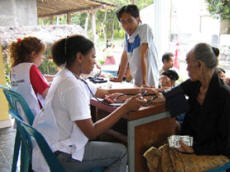 Three months have passed since a powerful earthquake devastated a large portion of the island
of Java and the members of Cuba's International Henry Reeve Contingent were swiftly
dispatched to Indonesia to help the victims.
The 135-member team worked in two field hospitals where it performed more than 2000 surgeries
and delivered at least 34 babies. The two field hospitals and the facility, as well as 60 tons
of medicines, are being handed over to the Indonesian government to support the rebuilding of
the local medical infrastructure.
Their job finished, the teams are heading home.
Three months have passed since a powerful earthquake devastated a large portion of the island
of Java and the members of Cuba's International Henry Reeve Contingent were swiftly
dispatched to Indonesia to help the victims.
The 135-member team worked in two field hospitals where it performed more than 2000 surgeries
and delivered at least 34 babies. The two field hospitals and the facility, as well as 60 tons
of medicines, are being handed over to the Indonesian government to support the rebuilding of
the local medical infrastructure.
Their job finished, the teams are heading home.
Return to Home